
2025 was the year CMMC stopped being theoretical and started impacting contracts, costs, and careers. For defense contractors, certification is no longer just compliance; it’s a competitive edge, a risk mitigation strategy, and an operational imperative in an era of elevated requirements for organizations in the Defense Industrial Base (DIB).
But it didn’t start that way. January 2025 was still a time of uncertainty and what felt like to many organizations, peak fear mongering. This wasn’t from a place of malice or a push for the market to start spending—compliance professionals, Certified CMMC Professionals and Assessors, and Authorized C3PAOs knew CMMC 2.0’s enforcement was coming, they just didn’t know when.
A Quick Recap: Why 2025 was Impactful for CMMC
2025 marked the transition of CMMC from concept to contract law.
This year saw:
- The rule formally adopted and published.
- Enforcement beginning with a clear timeline.
- Ecosystem expansion to support compliance.
- Industry facing real readiness challenges.
For defense contractors, these events reshaped how cybersecurity was managed, funded, and validated, and set the stage for accelerated adoption and enforcement through 2028 and beyond. But how did we get here?
The Lead Up to 48CFR
In January of 2025, the Department of Defense released a memo titled “Implementing the Cybersecurity Maturity Model Certification (CMMC) Program: Guidance for Determining Appropriate CMMC Compliance Assessment Levels and Process for Waiving CMMC Assessment Requirements.” This memo showed the clear direction the DoD was headed: CMMC enforcement was a priority and organizations could benefit from beginning to prepare.
While CMMC wasn’t officially signed into law or enforced in DoD contracts, the department was making it clear: you should anticipate enforcement and here’s how you should be doing it. This memo also reiterated earlier CMMC messaging that if organizations house CUI in their environment, it’s time to start building a robust and self-sustaining compliance program.
Despite this, many organizations still didn’t feel the need to prepare—it wasn’t official, it wasn’t in contracts, and 48CFR was still up in the air.
CMMC 2.0 Finally Became Real & Enforceable
After years of development, debate, and industry readiness questions, CMMC 2.0 crossed the finish line in 2025.
- On September 10, 2025, the Department of Defense published the final CMMC 2.0 rule in the Federal Register. This formally integrates CMMC requirements into defense contracts via DFARS clauses 252.204-7021 and 252.204-7025.
- The rule took effect on November 10, 2025, making CMMC standards enforceable and signaling the end of speculation — cybersecurity compliance is now a contractual requirement.
This shift moves CMMC from a long-anticipated idea to a legal and business reality for every contractor that touches Federal Contract Information (FCI) or Controlled Unclassified Information (CUI).
CMMC’s evolution in 2025 marked a shift in how the U.S. protects sensitive defense information:
- Cybersecurity compliance is now a gating factor for DoD contract eligibility—not a nice-to-have.
- The broader ecosystem, assessors, training bodies, tools providers, saw real scaling in response to market demand.
- Small and mid-sized companies, once concerned about ambiguity and excess costs, are now actively engaged with certification processes, sharing success stories, and building compliance into their core operations.
Looking ahead to 2026 and beyond, the emphasis will be on capacity, quality of assessments, and continued alignment between DoD policy and industry best practices.
What the Data Is Showing for CMMC in 2026
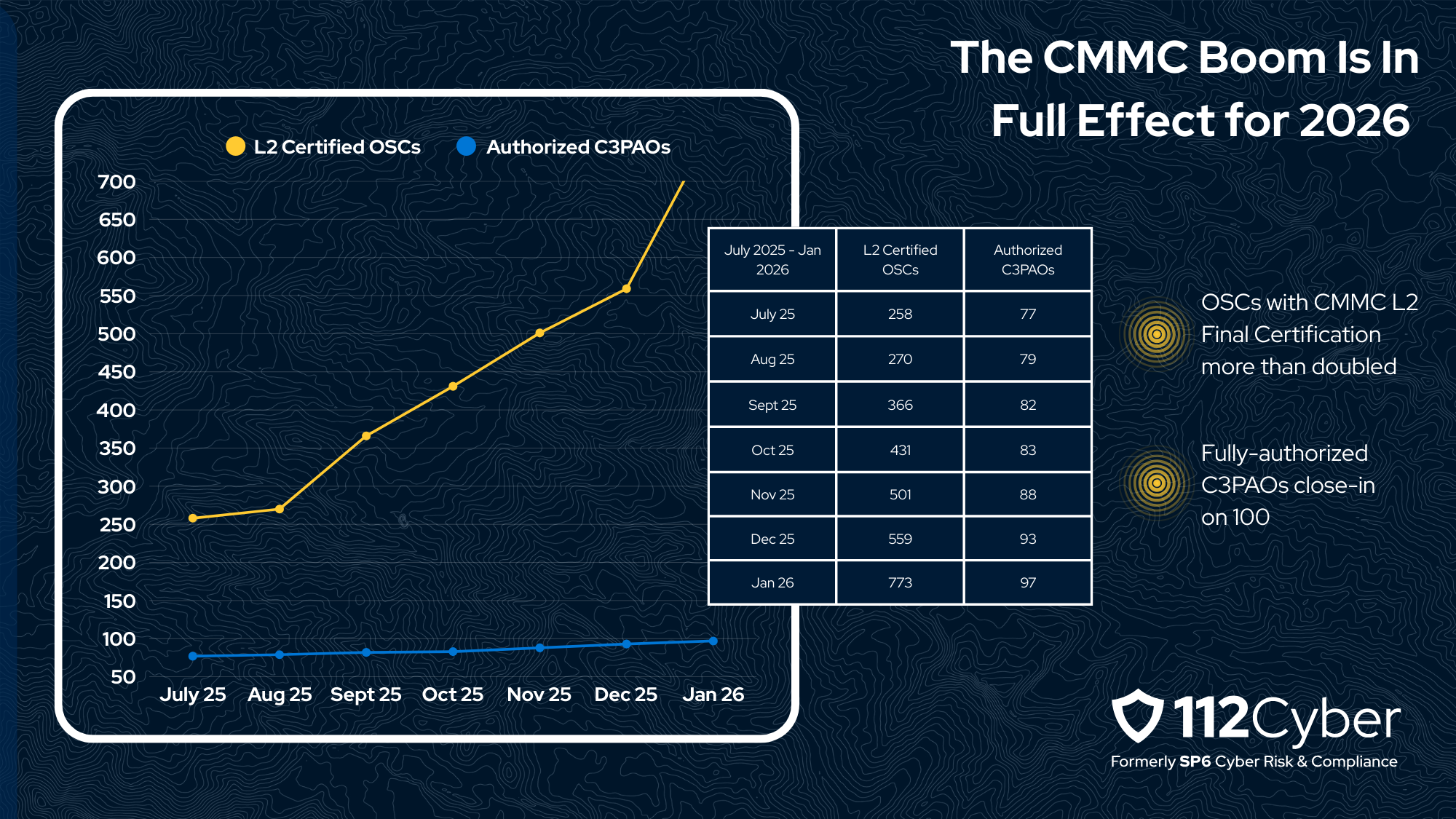
In a recent Cyber AB town hall, we learned that the defense industry has seen a nearly 200% increase in CMMC L2 Certified OSCs over the last 6 months.
Pairing this rapid growth with 48 CFR officially going into effect and a steady addition of authorized C3PAOs joining the ranks to serve organizations’ CMMC needs, the dedication to taking compliance requirements seriously is at an all-time high.
Our Projections for CMMC in 2026
As we look ahead through 2026, here’s what we think is likely to shape the CMMC space:
Broader Contract Integration
By late 2026, the DoD is expected to significantly widen CMMC clauses in solicitations — moving beyond self-assessments toward requiring third-party validated certifications (C3PAO) for higher-risk contracts. This shift is built into the phased rollout. Currently, more and more contracts involving Controlled Unclassified Information (CUI) now require Level 2 certification from a C3PAO (Certified Third-Party Assessment Organization). While self-assessments were common early in the rollout, 2026 is seeing greater reliance on independent validation.
Assessment Capacity Is a Bottleneck
With a surge in required Level 2 assessments, demand for accredited C3PAOs will likely outpace supply — driving delays and increased costs for certification preparation. Early planning will be essential to meet deadlines and secure assessment slots. We’re already seeing demand for assessments rise faster than assessor availability. Many mid-tier and small contractors are discovering that scheduling assessments requires months of lead time.
Compliance Ecosystem Growth
Expect to see a vibrant ecosystem of compliance services from policy automation tools to cybersecurity consultancies helping small and mid-tier contractors achieve CMMC certification efficiently. Early movers may gain competitive advantages in defense procurement. Prime contractors are tightening subcontractor requirements to reduce risk exposure. Even organizations not directly contracting with DoD are feeling pressure through flow-down clauses, and this increases demand for compliance services exponentially.
What 2026 Means for Different Types of Contractors
Small Businesses
For small and mid-sized contractors, 2026 is a pivotal year. Those that invested early in CMMC readiness are now positioned to:
- Win contracts where competitors cannot qualify
- Serve as compliant subcontractors to major primes
- Reduce risk of False Claims Act exposure tied to cybersecurity assertions
Those who delayed preparation are encountering compressed timelines and higher remediation costs.
Prime Contractors
Larger primes are strengthening oversight mechanisms, including:
- Formal supplier cybersecurity reviews
- Contractual certifications tied to CMMC levels
- Integration of CMMC status into procurement decision systems
For primes, CMMC in 2026 is as much about risk management as compliance.
What This Means for Your Organization
If you’re involved in defense contracting, here’s a practical takeaway:
- Prepare Now: Waiting until solicitation release is no longer viable — CMMC is already live and growing.
- Understand Your Scope: Assess whether your systems process FCI or CUI — this determines the level of certification you’ll need.
- Build Compliance into Operations: Successful CMMC compliance requires documented controls, ongoing monitoring, and periodic assessment — much more than a one-time effort.
- Plan for Audits: With 2026 ushering in more third-party certification requirements, begin engaging with assessors early to avoid backlogs.
Conclusion
CMMC in 2026 is no longer about if compliance is necessary—it’s about how efficiently and strategically organizations can achieve and maintain it.
The companies that treat CMMC as a checkbox will struggle. The companies that integrate it into governance, risk management, and operations will gain a significant advantage.
Need a boost to get started or move your compliance program along? Whether you’re looking for consulting to mature your compliance program or want to start the process of an L2 assessment, we’re happy to help!